A Values-Centered Framework in the Age of AI
Sub-pages:
- Philosophy & Worldview
- Core Moral Framework (SSMV)
- Human Dignity Model
- Knowledge–Ethics Integration
A Values-Centered Framework in the Age of AI
Hero Section
The Salahi System
Clarity in values. Discipline in action. Dignity in progress.
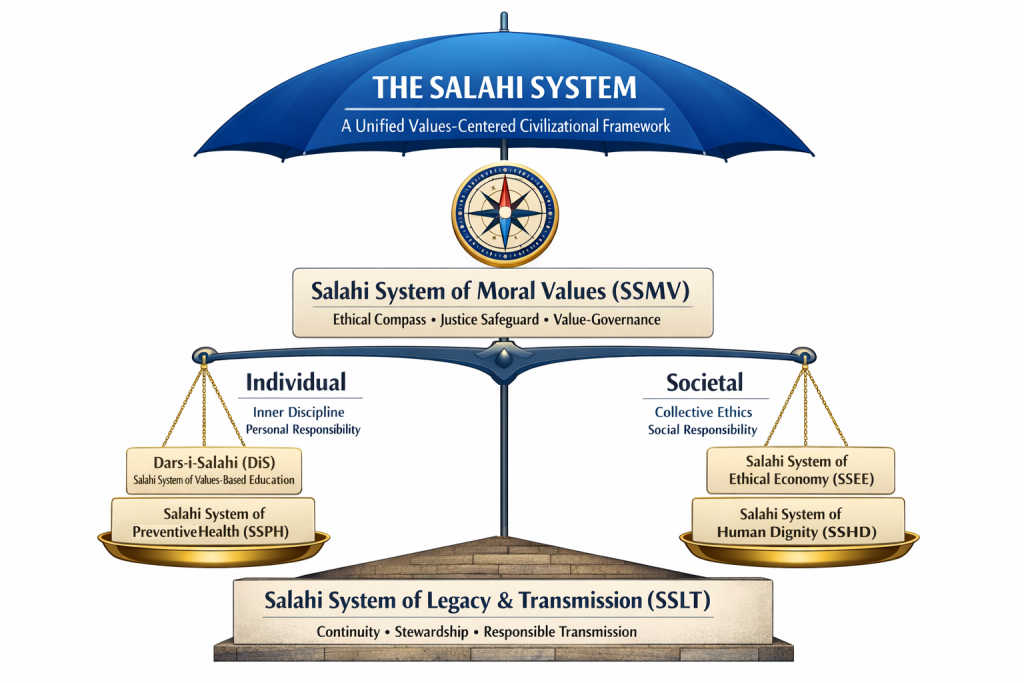
The Salahi System is a values-centered, purpose-driven framework for holistic human development.
It integrates education, ethical economy, preventive health, and social dignity within a single moral vision—designed for life in the digital age.
In a world where values are frequently discussed but rarely systematized or lived consistently, the Salahi System provides structure, discipline, and continuity.
It is not a campaign, ideology, or trend.
It is a long-term system of thought and practice, built to endure beyond individuals.
What Is the Salahi System?
The Salahi System organizes values into disciplined frameworks, ensuring that ethics move beyond abstraction and become habits, decisions, and systems that shape real life.
Rooted in Islamic moral philosophy and informed by reason, experience, and contemporary realities, the Salahi System aligns:
- belief with conduct
- knowledge with responsibility
- capability with conscience
Its aim is to form individuals who are morally grounded, intellectually clear, and socially responsible—before they act in society.
The Moral Core
Salahi System of Morality (SSM)
At the heart of the Salahi System lies the Salahi System of Morality (SSM).
SSM is the ethical core that governs all other components.
It defines values, moral conduct, responsibility, and justice as lived realities, not theoretical ideals.
SSM establishes foundational principles such as:
- responsibility before authority
- discipline before influence
- dignity before efficiency
- justice as an ethical safeguard when dignity is threatened
All sub-systems derive their direction, limits, and accountability from this moral core.
Without moral clarity, no system—especially in the digital age—can remain sound.
How the System Is Structured
The Salahi System operates through four interrelated sub-systems, organized across two levels of application, all governed by SSM.
A. Individual Formation Systems
Formation precedes participation
1. Dars-i-Salahi (DiS)
Values-Based Education System
An educational framework that emphasizes formation over information, character over performance, and purposeful learning over mere certification—across school, university, and professional education.
2. Salahi Preventive Health System (SPHS)
Before Illness
A preventive, responsibility-based approach to health that prioritizes self-care, balance, discipline, and awareness—addressing well-being before illness and hospitalization become necessary.
B. Collective & Societal Systems
Participation follows formation
3. Salahi Ethical Economic System (SEES)
A values-guided economic framework for livelihood, trade, business, and digital economy—where fairness, responsibility, and human well-being govern profit and growth.
4. Salahi Human Dignity System (SHDS)
A social framework affirming inherent human dignity, moral agency, education, participation, and responsibility for all—men and women—within an ethical and balanced social order.
Justice operates here as a protective moral principle, activated whenever dignity is compromised.
How the Salahi System Operates
The Salahi System is:
- system-led, not personality-driven
- principle-anchored, not trend-based
- deliberate, not rushed
- documented, not improvised
Growth within the system is measured, ethical, and sustainable.
Expansion follows clarity—not the reverse.
A Long-Term Vision
Built to Endure
The Salahi System follows a long-term developmental vision in which:
- clarity precedes expansion
- formation precedes application
- documentation precedes institutionalization
This protects the system from fragmentation, misuse, ideological capture, and moral drift—especially in rapidly changing digital environments.
Foundational Statement
The Salahi System exists to restore moral clarity to life, discipline to action, and dignity to progress—through systems designed to endure beyond individuals. The system forms the individual before structuring society, and governs both through a single moral core.
Foundational Axioms of the Salahi System
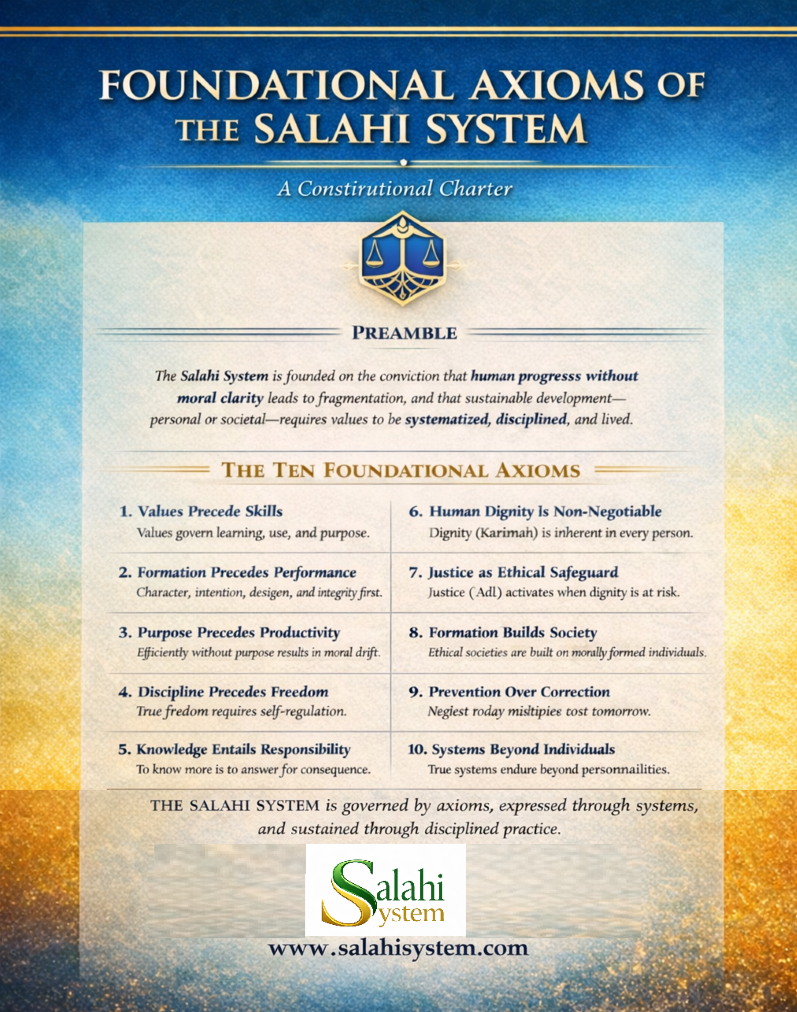
Axiom 1 — Values Precede Skills
No skill, technology, or competence is morally neutral.
Values must govern what is learned, how it is used, and to what end.
Skill without values produces efficiency without conscience.
Axiom 2 — Formation Precedes Performance
Human formation—character, intention, discipline, and integrity—must come before measurable output or achievement.
What a person becomes matters more than what a person produces.
Axiom 3 — Purpose Precedes Productivity
Activity gains meaning only when guided by purpose.
Productivity without purpose leads to exhaustion, misuse, and moral drift.
Not all efficiency is progress.
Axiom 4 — Discipline Precedes Freedom
True freedom is not the absence of limits but the presence of self-control.
Discipline is the condition that makes meaningful freedom possible.
Undisciplined freedom destroys itself.
Axiom 5 — Knowledge Entails Responsibility
Every increase in knowledge increases moral responsibility.
To know more is to be accountable for consequences.
Ignorance may excuse; knowledge obligates.
Axiom 6 — Human Dignity Is Inherent and Non-Negotiable
Every human being possesses dignity (karāmah) by virtue of being human.
No system, efficiency, ideology, or technology may override this dignity.
Means are never more important than persons.
Axiom 7 — Justice Operates as an Ethical Safeguard
Justice (ʿadl) functions as a corrective and protective principle when dignity is threatened.
It is ethical before it is legal, and moral before it is political.
Justice is activated when dignity is at risk.
Axiom 8 — Formation Begins with the Individual and Scales to Society
Sound societies are built from formed individuals.
Social, economic, and institutional systems must rest on individual moral formation.
No ethical society can be built from unformed individuals.
Axiom 9 — Prevention Is Superior to Correction
Whether in morality, health, education, or society, prevention is wiser than repair.
Neglect today multiplies cost tomorrow.
What is not disciplined early becomes crisis later.
Axiom 10 — Systems Must Endure Beyond Individuals
Truthful systems do not depend on charisma, personalities, or moments.
They are documented, transmissible, and capable of continuity.
A system that collapses without its founder was never a system.
Structural Note (Very Important)
These axioms:
- govern all Salahi sub-systems (DiS, SEES, SPHS, SHDS)
- do not change with context
- precede policies, curricula, and institutions
- function as ethical constraints, not optional ideals
Founder’s Constitutional Statement
The Salahi System is governed by axioms,
expressed through systems,
and lived through disciplined practice.
Explore Further
- Salahi System of Moral Values (SSMV)
- Dars-i-Salahi (DiS) — Salahi System of Values-Based Education (SSVE)
- Salahi System of Ethical Economy (SSEE)
- Salahi System of Preventive Health (SSPH)
- Salahi System of Human Dignity (SSHD)
- Salahi System of Legacy & Transmission (SSLT)
THE SIX PILLARS OF LIFE SYSTEM
| Health (Prevention) | Daily lifestyle discipline: sleep, diet, movement, stress control, habit formation—health before illness. | Salahi System of Preventive Health (SSPH) |
| Dealings (Economy) | Earning, spending, trade, and work ethics: halal income, fairness, trust, moderation, and responsibility. | Salahi System of Ethical Economy (SSEE) |
| Attitude (Human Dignity) | Conduct with people: respect, justice-minded behavior, speech ethics, boundaries, and non-humiliation in private and public life. | Salahi System of Human Dignity (SSHD) |
| Legacy (Transmission) | Continuity beyond the individual: documentation, mentorship, succession, institutional memory, and transmission of values. | Salahi System of Legacy & Transmission (SSLT) |
SALAHI EDUCATION POLICY – “SALAHI SYSTEM OF EDUCATION”
Motto: Taleem + Tarbiyyat + Tadreeb + Tehqeeq + Tableegh
| Element | Meaning | Application |
|---|---|---|
| Taleem | Knowledge + Critical Thinking | AI-assisted, project-based learning |
| Tarbiyyat | Character Development | Daily moral reflections & mentorship |
| Tadreeb | Professional Practice | Real-life internships & digital labs |
| Tehqeeq | Research & Innovation | Qur’anic reasoning + modern science |
| Tableegh & Khidmat | Social Reform | Community projects + digital da’wah |
Leave a Reply
Logged in as drsalah. Edit your profile. Log out? Required fields are marked *
Comment *